
Sikkim
West Sikkim
From wildlife parks offering the simplest of jungle adventure to remote Himalayan villages submerged in rustic charm, West Sikkim has no dearth of wonderful destinations. Explore beautiful monasteries, trek on undulating terrains, befriend locals, and luxuriate in local delicacies you'll explore and knowledge.
Places to Visit
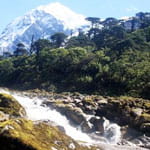
Kanchenjunga park
West Sikkim boasts of powerful biodiversity, and therefore the best thanks to exploring it's paying a visit to Kanchenjunga park. Teeming with exotic flora and fauna species, glacial lakes, glaciers, an extensive range of forests, and far more, Kanchenjunga park was listed as a UNESCO World Heritage Site within the year 2016.
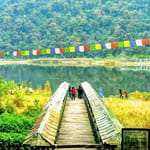
Khecheopalri Lake
Khecheopalri Lake is taken into account to be a sacred lake by the locals. it's situated within the dense dark forest with impressive foliage which adds to the sweetness of the lake. it's believed that the leaves aren't permitted to float on the lake therefore the birds pick them up as soon as they fall.
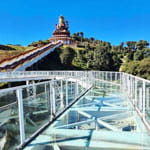
Pelling
Pelling may be a hill station located at an altitude of seven,200 feet. It lies within the foothills of snow-laden mountains and provides magnificent views of the peaks like Kanchenjunga, Koktang, Rathong. Pelling also is a base camp for several famous treks here.
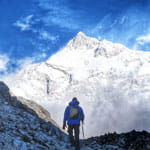
Goecha La
Goecha La may be a high-altitude pass claiming an elevation of 16,207 feet. the location exhibits an ideal blend of adventure and nature’s artistry. Explore the mighty Himalayas while trekking amidst verdant meadows, picturesque valleys, streaming rivers, striking lakes, snow-capped mountains and deep forests. While trekking to the pass, you'll savour views of the imposing mountains like Kanchenjunga, Talung, Rathong and lots of others.
Yuksom Village
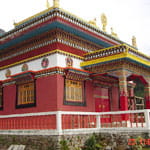
Yuksom is an old historic town, which is taken into account to be amongst the simplest places to go to in West Sikkim bestowed with natural beauty and uninterrupted trail for trekkers. If you're looking forward to spending some quiet moments within the shadow of nature far away from the hustle-bustle of the town, then this is often it.
South Sikkim
South Sikkim is a perfect destination for adventurists also as nature lovers and in fact for those that are seeking a getaway from the touristy places and bustling city life. The region offers bountiful opportunities for angling, rafting, camping, trekking and wildlife exploration alongside obtaining complete peace of mind, body and soul. Indeed, South Sikkim tour can convince be a healing agent and thus it should go unmissed.
Places to Visit
Samdruptse
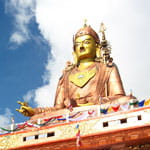
Nestled at 7000 ft and situated 5km from Namchi, this great Buddha statue is one of the must-visit places in South Sikkim. It is one of the largest statues of Buddha (Guru Padmasambhava) and stands tall at the hilltop. Not only a place of sacred relevance, but the tourists experience the ultimate sense of peace and witness excelling architecture.
Buddha Park
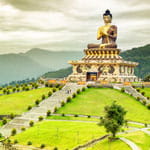
It is a serene site of soulful exploration in South Sikkim. This park is an attractive place to see and it is surrounded by lush gardens, peaceful surroundings, and it has an ample walkway for visitors. From here, you can witness an uninterrupted view of the mountains.
Temi Tea Garden
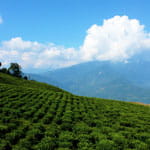
Temi Tea Estate is situated in Ravangla; which is quite popular for village tourism. There are many petite villages rearing in this beautiful land such as Narsing Village, Borong Village, Kewzing Village and many others, offering an enriching demonstration of their colourful culture and traditions.
Borong
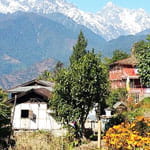
A scenic village, Borong is a perfect trekking destination in South Sikkim. Overlooking the mighty mountains, this village is blessed a gorgeous landscape and spectacular views. The trek begins from Namchi then crossing Tendong, Rabong and Maenam, it reaches the ultimate destination of Borong. One can catch a glimpse of a number of the majestic Mt. Kanchenjungha and peaks like Sinolchu, Narsingh and Pandim and therefore the spectacular sight of sunrise from the snow-covered mountains is additionally a guarantee.
Chardham
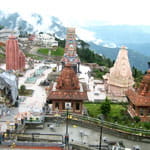
Pilgrimage-cum-Cultural Centre is constructed on top of Solophok Hill in South-Sikkim. View for miles, the 26 and a half m high statue of Lord Shiva in sitting posture that marks the location of the main temple. It is a site to attain a complete peace of mind and experience a state of calmness especially for the hindus.
East Sikkim
East Sikkim is the part with the highest temperature as compared to other parts, classifying Gangtok; the capital city of Sikkim in its arms, which also presented as the centre of all the executive liveliness on the state. Being well connected to all or any of the tourist hotspots of Sikkim and studded with the foremost popular destinations in itself, the tourists visit here in search of enchantment, trekking also as solace. The list of must-visit places within the Eastern region of Sikkim is unending.
Places to Visit
Rumtek Monastery
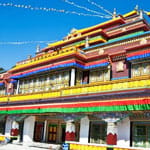
Rumtek Monastery is nestled within the Rumtek District of Sikkim and is one among the simplest East Sikkim tourist places, located nearly 23 km far away from the most town of Gangtok. Rumtek is additionally one among the most important and hottest monasteries of Sikkim, belonging to the Kargyu sect of Buddhists. It also bears a remarkable likeness to the famous Tsurphu Monastery of Tibet.
Zuluk Old Silk Route
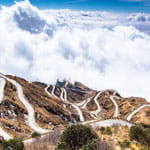
The Old Silk Route or Silk Road which passes through East Sikkim is a part of the ancient network of trade routes that connected China to India. This route passed through Lhasa and Nathu La and Jelep La Pass and finally reached the port of Tamralipta (present Tamluk in West Bengal) from where it took to the sea and reached far east.
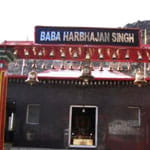
Baba Harbhajan Singh Mandir
Baba Mandir is a holy memorial situated at a distance of 50 km from Gangtok towards the Nathula Border between China and India. Baba Harbhajan Singh Temple is a unique stop mainly due to the legacy associated with it. It is believed that his spirit guards every soldier in the high-altitude terrain of the Eastern Himalayas.
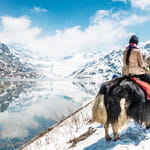
Tsomgo Lake
Tsomgo lake which is found just 38 km far away from the capital city of Sikkim, Gangtok, is among the foremost popular tourist places in Sikkim. A snaky road through Rocky Mountain topography and strident mountains which takes you to Tsomgo Lake may be a lot of adventure in itself.
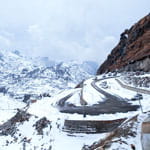
Nathula Pass
Nathula pass, located within the Himalayas, connects India with Tibet is taken into account to be amongst the simplest places to go to in Sikkim Gangtok. The pass, at 4,310 m above water level forms a neighbourhood of a side-shoot of the prehistoric Silk Road. Definitely one among the places to go to in Sikkim without fail.
North Sikkim
One of the foremost unoccupied areas of the country, yet enormouslystunning and appealing, North Sikkim dividends its border with China and Nepal. It's one among the foremost mystically beautiful though unexplored areas thanks to the tough conditions found here. North Sikkim is legendary for the Gurudongmar Lake which is one of the very best lakes in India. It also has religious importance. aside from the lakes, there are some important monasteries during this area too.
Places to Visit
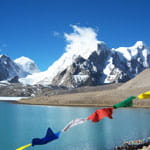
Gurudongmar Lake
The Gurudongmar Lake is established at a top of 5,210 m and is taken into story holy by Buddhists, Sikhs and Hindus alike. per annum during the elevation season, enthusiasts and visitors congregate to the present place.
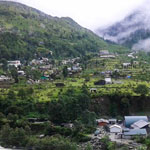
Lachung Village
Situated at an altitude of 3000 m, Lachung may be a old-fashionedpetite town on the Northern side of Sikkim. Lachen is settled where two streams of Teesta River-Lachen and Lachung converge.
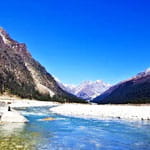
Yumthang Valley
Yumthang Valley (3564 m) is popular among tourists for its beautiful scenery and therefore the spell-bounding prospects of the hills beyond. The river Teesta flows within the valley, delivering this a feeding spot for the animals during the summers.
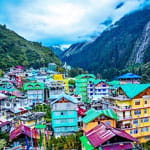
Lachen Village
Resided at an elevation of 8838 feet within the northerly part of Sikkim, Lachen is one of the leading attractive places inside the whole of Sikkim. It's renowned for its beautiful scenery and its beautiful perspectives of the hills and lush green surroundings
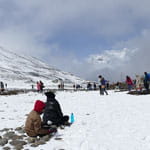
Yumesamdong 0 Point
Yumesamdong otherwise referred to as zero, is one among the foremost frequented tourist's places in Lachung. It's nestled about 15 km far off Yumthang and elevated at 4,724 meters. Zero-point marks the sting of civilization, and therefore the road involves a dead-end here. Yumesamdong brings you exceptional rewards! Satisfy your sight to the junction of three majestic rivers, flanked on either side by gigantic, snow-clad mountains. While yaks often graze here, the land is almost competent barren of vegetation. The place sits beneath thick, powdery snow, and brings extreme weather conditions.
Darjeeling
Right at the foothills of the Himalayas, Darjeeling attracts all those that wish to experience life because it once was before the times of modernization. While lovers and honeymooners visit the town and book themselves in cosy cottages to enjoy private time far away from the town, the tired travellers go soul searching within the hills. The foremost popular activities in Darjeeling were once trekking, camping and bird watching, but over the years, a replacement discovery has been made. foam rafting is fast becoming the foremost popular activity in Darjeeling. Unmatched in thrill and action, this is often the simplest thanks to experience the gushing waters of the Teesta and Rangeet rivers.
Places to Visit
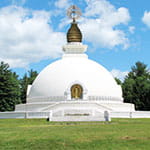
The Peace Pagoda
The Japanese Peace Pagoda on the slopes of Jalaphar Hill may be a short distance from the town and showcases the four avatars of Buddha, including the Maitreya Buddha. It's hospitable people of all races and creeds and is purposely made to propagate peace and prosperity within the world.
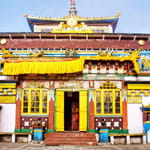
The Ghoom Monastery
The Ghoom Monastery, built-in 1875 by a lama called Sherab Gyatso, is that the largest in Ghoom (8 kilometres from the town of Darjeeling) and holds the statue of the Maitreya Buddha, supposed to be ‘The Buddha to Come’. The statue may be a whopping 15 feet tall
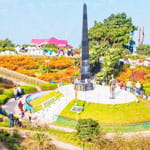
Batasia Loop
Reach Batasia loop at nine within the morning and you will see the foremost amazing spectacle ever - shopkeepers with their little makeshift stalls and curio-spreads on the railway lines conclude their business with superb agility and speed because the Toy Train arrives to traverse this tiny loop.
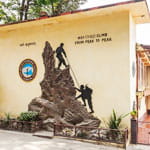
Himalayan Mountaineering Institute and Zoo
The Himalayan Mountaineering Institute was established by Tenzing Norgay, the sherpa who, alongside Sir Hillary, reached the summit of Everest. The campus features a memorial for him, and it also houses a museum that showcases mountaineering equipment. These include those that Tenzing Norgay used.
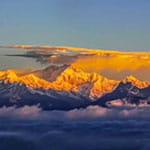
Tiger Hill
Tiger Hill, the very best point, a brief chase away from the town is right for hiking and trekking through the day. Besides astonishing views of the Kanchenjunga Range, Tiger Hill extractsflawlessviews of the sunrise.
Nepal
A hub for the adventure-lovers and residential to Mt. Everest, the world's tallest peak, Nepal may be a Himalayan country sandwiched between India and China. The mighty snow-capped mountains here like Annapurna, Everest, Manaslu, and Kanchenjunga are home to a number of the simplest trekking trails within the world. Nepal is additionally a serious spiritual centre with its many trip sites for the believers of Buddhism and Hinduism just like the Pashupatinath Temple and therefore the Boudhanath Stupa. Lumbini, a little Buddhist hub in Nepal is the birthplace of Lord Buddha.
Places to Visit
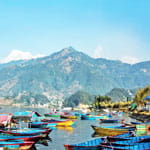
Pokhara
Pokhara, the 'Tourist Capital of Nepal,' is that the second-largest city in this Himalayan country, after Kathmandu. At an altitude of quite 900m, it's one among the very best cities, making it the bottom for several world-famous treks.
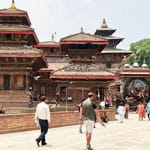
Kathmandu
Kathmandu, the town of peace, lives faithfully to this description. The town is beautiful, energetic, bustling, content, growing and asleep - all undeviatingly. The capital of Nepal, Kathmandu is that the most accessible city within the country - it's Nepal's only metropolitan city also.
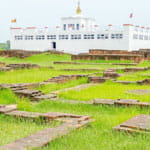
Lumbini
Nestled within the Himalayas near the Indian border, the gorgeous town of Lumbini is that the birthplace of Lord Buddha. Lumbini may be a UNESCO World Heritage Site and features aoverabundance of ancient stupas dating back to more than 1500 years and hermitages that were constructed by past families.
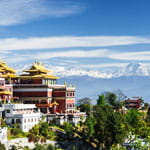
Nagarkot
Located at a mere 28-kilometre chase away from Kathmandu, Nagarkot offers one among the simplest views of the Himalayas within the entire region because it has an altitude of 7000 feet (2000 metres)! Perched at the sting of Kathmandu Valley, Nagarkot gives you one among the widest panoramas of the Himalayan ranges.
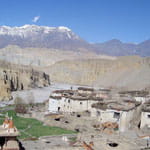
Mustang
Occupied by the southern fringes of the Tibetan plateau, a high and desolate country where variegated rocks, shadows of passing clouds, and a couple of cultivated fields provide interesting colour and contrast. Culturally and historically very on the brink of Tibet, Mustang was an independent feudal kingdom with strong monastic traditions and thrived on its control of trading routes connecting Tibet with Nepal and therefore the Indian plains. When Nepal opened its borders to tourists, trekkers, and mountaineers within the early 1950s, political events to the north caused Mustang to stay isolated.
Bhutan
The ‘Land of the Thunder Dragon’ – Bhutan nestles within the mountainous regions of the Eastern Himalayas and is one of the cleanest countries within the South Asian territory. a foreign kingdom that also clings to its Buddhist culture but embraces modernisation, Bhutan maybe land with monasteries, traditional architecture, beautiful valleys, snow-clad mountain views and lush greenery. Being Landlocked the country enjoys a big tourist influx from its neighbours Tibet and India.
Places to Visit
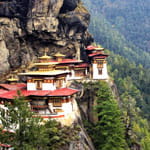
Paro
Paro may be a village situated within the Paro Valley of Bhutan. it's one among the foremost fertile also because of the historic valley of Bhutan which is that the widest within the Kingdom. It boasts of 155 temples and monasteries courting back to the 14th century. Paro is also Bhutan's only international airport.
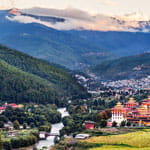
Thimphu
Thimphu is understood because the heart of Bhutan nestled in its central-western part. Substituted by Bhutan's ancient capital - Punakha, Thimphu was acknowledged the capital city of the Bhutan within the year 1961. Originally pronounced as 'Thimbu', the town is understood because of the most modernised place in Bhutan with internet cafes, restaurants and pubs.
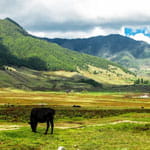
Phobjikha valley
Against the backdrop of western slopes of the Black Mountains in WangduePhodrang, lies the bowl-shaped Phobjikha valley that gives breathtaking views of vast expanses of green fields. it's home to the endangered black-necked crane that migrates to the present area during winters.
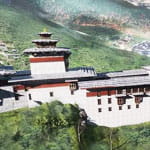
Wangdue Phodrang
Being one among the most important Dzongkhangs (District) of Bhutan, WangduePhodrang has everything from monasteries and temple to wildlife and rustic villages. the rationale why the region is different as compared to others is that it's very diverse in terms of subtropical forests within the south to cold, snowy areas within the north.
Kalimpong
Kalimpong may be a charming hill station in West Bengal famous for its picturesque canyon landscapes, Buddhist’s monasteries and chapels and Tibetan workmanship etc. Located in close proximity to Darjeeling, Kalimpong is settled on the foothills of Shivalik ranges at an elevation of 1250 m facing the Teesta Valley. People say that the world was ruled by Bhutanese kings and was a forward post of the Bhutanese Army till the 19th century. Dotted with ancient Buddhist monasteries, centuries-old churches and exquisite revered temples Kalimpong marks the Bhutanese history till it had been wrested by British rulers.
Places to Visit
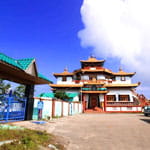
Durpin Dara hill
Offering the bird's eye view of the town of Kalimpong, the snow-clad Himalayan ranges of West Sikkim, the Teesta River and its valleys, Durpin Dara Hill also features golf links and therefore the Zang DhokPalri Monastery. There's also a famous arboretum there.
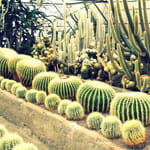
Cactus Nursery
The land of the most important number of economic flower nurseries Kalimpong nurseries concentrate on the cultivation of exotic beautiful flowers and export these flowers to different parts of the country. There are numerous nurseries across the town so you'll enjoy some sweet time there. One among such nurseries is Pine View Nursery which is legendary for its exotic cactus.
Deolo Hill
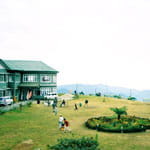
Deolo Hills is found at an elevation of around 2000 m and thus, provide an excellent bird's eye view of Kalimpong. There also are proper viewpoints which are located at the ridge edges for the simplest view of the sunset and sunrise.
Jang Dog PalriffoBrang Gompa
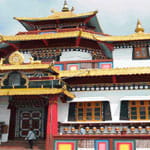
Anointed by Dalai Lama in 1976 Jang Dong PalriffoBrang Gompa is additionally connected to as Durpin Monastery. The monastery is a sample of Buddhist construction style with beautiful paintings on the walls and therefore the sacred Kunguyar function as a crucial feature of this monastery.
Morgan House
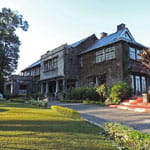
Positioned within the flourishing greens of Kalimpong, Morgan home is a palace-like created by Mr and Mrs Morgan within the 1930s. It's an archetypal symbol of colonial planning and structure in Kalimpong. It's been transformed into a dormitory for tourists and is under the authority of the West Bengal Tourism Development Corporation.